

Youth in Motion: Financial Inclusion for Young Refugees
Updated: Sep 23
By Myka Reinsch Sinclair & Joana Silva Afonso, UNHCR
Although financial inclusion for both young people and refugees has grown in prominence in recent years, tackling the unique financial inclusion challenges of displaced youth is still in its early stages. In this blog, Myka Reinsch Sinclair and Joana Silva Afonso from UNHCR dive into understanding and recognising the specific challenges it faces, and then, using several examples, explore how to meet displaced youth on their journey towards financial inclusion.
This blog is part of the Luxembourg Award for Inclusive Finance (LAIF) 2026 (formerly the European Microfinance Award), on the topic of ‘Unlocking Youth-Inclusive Finance’.
Unlocking youth-inclusive finance is difficult in any context, but reaching young refugees is harder still. The population is substantial: we estimate based on demographic data that of the 117.8 million forcibly displaced people worldwide, nearly 19 million are youth ages 15-24. As the 2026 Luxembourg Award for Inclusive Finance concept points out, equipping youth with appropriate financial products and complementary non-financial services has been shown to have strong positive impacts on their lives. The potential for such impact is even greater for displaced youth facing life-changing ruptures in education, employment and community connections. Although youth financial inclusion and refugee financial inclusion have each gained traction in recent years, tackling the unique financial inclusion challenges of displaced youth is still nascent.

Understanding the compound challenge
Even before displacement enters the picture, young people start behind. Globally, 69% of 15-to-24-year-olds hold a bank account, compared to 79% of adults; this 10-percentage-point gap is consistent, even though overall levels of account ownership are typically much lower in countries most affected by displacement. To move the needle on the youth financial inclusion gap, sector stakeholders have to consider the evolving needs of young adults. The concept note behind this year’s Award describes youth as people in motion, moving between life stages, from school to work and from dependence to independence. Forcibly displaced youth know all about transition. For them, it is not just moving from adolescence to adulthood—they are simultaneously grappling with traumatic shifts in community, geography, language, culture and quality of life.
Within refugee programming, under-18s receive child-focused protection and education services, while over-18s merge into livelihoods and other services for adults of any age. As in the general population, the distinct life-cycle needs of displaced youth then go unaddressed by financial service providers and others building refugee economic resilience. The ordinary barriers facing young clients—thin credit histories, few assets and little experience of formal finance—are compounded by the documentation gaps, know-your-customer hurdles and restrictions on the right to work and move that often come with displaced status. The result is a segment whose exclusion runs deeper than that of young people or refugees considered separately.
Recognising the potential
Displaced youth often show remarkable adaptability and a drive to become positive change agents for their communities. With appropriately tailored financial and nonfinancial tools, they can forge a path that not only improves their own lives and livelihoods, but also makes a difference for their families and even the broader community. So the upside of investing in them is considerable.
The refugee youth-led organisation UNLEASHED operating in Uganda's Nakivale settlement since 2018 offers a glimpse of the possibilities. With support from the Netherlands-funded PROSPECTS partnership — of which UNHCR is one of five partner agencies — UNLEASHED delivers what has become its largest programme to date, combining financial education, personal development, business coaching and seed funding through the UPSHIFT programme led by ILO and UNICEF. The initiative accompanies young refugees and their host-community peers from an initial business idea to launching and running an enterprise. To link participants with bank accounts, the organisation also partners with Opportunity Bank Uganda, a local microfinance bank and a member of an international microfinance network.
There were concrete results: young people affected by displacement launched ventures such as soap production, a bakery, fruit-juice making and a mosquito-repellent business. Just as importantly, the model multiplies itself: the programme is designed so that youth who complete the programme go on to train the next cohort of refugee and host-community innovators. By deliberately serving refugees and host community youth side by side, this strengthens ties between the two communities. The UNLEASHED experience shows that, given the opportunity, displaced youth often have the energy, drive and capacity to overcome their circumstances and transform not only their own futures but those around them.
Reconsidering the risk
The instinct of financial service providers is to treat both youth and refugees as segments to approach with caution: unfamiliar, commercially uncertain, transitory, risky. The evidence tells a different story. Just as many financial inclusion stakeholders have found youth to be committed savers, disciplined borrowers and valuable long-term clients, refugee finance stakeholders are reaching the same conclusion about displaced clients.
Kiva, one of the largest funders of refugee lending worldwide, reports that refugees repay at rates on par with non-refugee borrowers, and calls the perception of refugees as a riskier market largely a myth. In Uganda, the first commercial bank branch inside the Nakivale settlement, opened by Opportunity Bank, broke even within its first year and now ranks among the bank’s best performers. Similarly, after a 2022 needs assessment in cooperation with IFC, Financiera Confianza in Peru expanded its services to migrants and refugees. Its “Confianza sin fronteras” programme was reaching close to 7,000 customers as of late 2024 with savings, loans and insurance.
Age-disaggregated client data is not yet adequately available to analyse the performance of the 15-24 age segment. But if youth and refugees are both proving more bankable than expected, then financial service providers are likely to find another double-bottom-line market opportunity in displaced youth.
Meeting displaced youth on their journey
For youth, and even more for displaced youth, financial inclusion enables the transition to economic adulthood: transaction accounts, savings, appropriate credit and insurance support young people as they move from learning to earning and from dependence to self-reliance. UNHCR works with partners worldwide to extend such products and services to displaced youth as they grow and mature. A few examples show what this looks like in practice.
Displaced youth need a way to complete their studies and then to transition from being a student to becoming a worker. UNHCR’s partnership with the Mastercard Foundation, under its Young Africa Works, aims to support more than half a million refugees and displaced youth across Africa to complete their education, and 200,000 young people to move into dignified work by 2030, with a deliberate focus on young women and persons with disabilities.
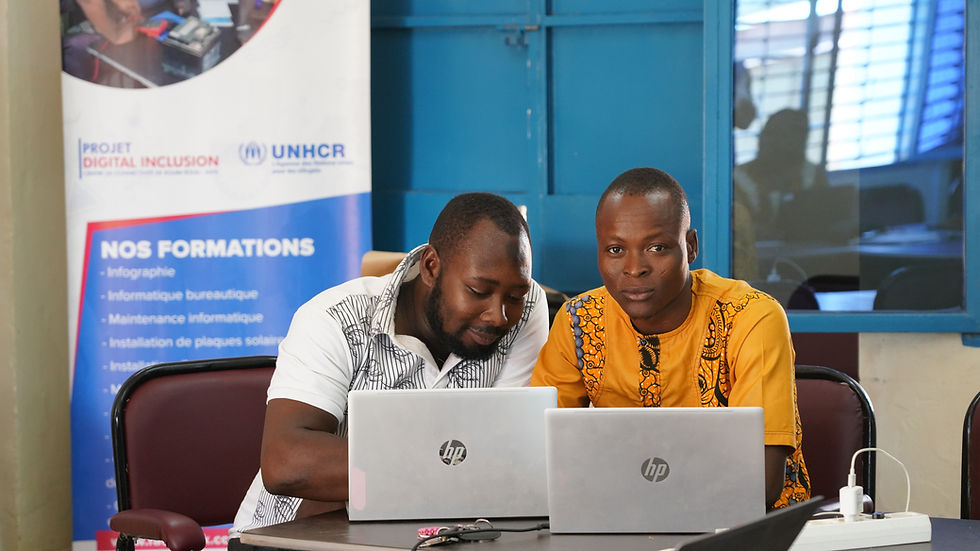
Another approach equips displaced youth to build financial independence via entrepreneurship. In the Bidi Bidi settlement in Uganda, two refugee-led organisations, Bridging Gaps and the Afri-Youth Network, run a pay-it-forward microloan model with support from UNHCR’s Refugee-led Innovation Fund. Donations are converted into interest-free microloans, accompanied by training and mentorship. Once a young entrepreneur’s business is established, they pass the loan on to another youth in the same community and serve as a mentor themselves. The programme design is notable in two ways: it is led by displaced people rather than delivered to them, and it treats finance and related business support as a single package rather than separate interventions.
As they build their livelihoods, displaced youth need financial services — and the knowledge to use them well. Often quick adopters of digital finance, they gain opportunity but also exposure to risks around data use, aggressive marketing and opaque provider practices, frequently without a family member experienced in formal finance to guide that first encounter — which is why financial education and consumer protection are decisive. UNHCR builds this into its work to enhance financial inclusion for displaced persons. In Uganda, a programme with the Swedish International Development Cooperation Agency and the Grameen Crédit Agricole Foundation combined financing for inclusive financial institutions with entrepreneurial training and financial literacy for more than 100,000 refugees and host-community members. Research on the outcomes and impacts of such initiatives is still needed.
Addressing this overlooked segment
There is a precedent for what focused attention can achieve in the financial inclusion sector. Women’s financial inclusion, for instance, demonstrates what is possible when a population segment is recognised as having distinct barriers, needs and opportunities. While significant challenges remain, the financial inclusion gender gap has narrowed thanks to dedicated research, client segmentation, tailored products, policy advocacy and gender-lens investment. Given the scale and youth of displaced populations—and the potential they have for addressing intergenerational poverty among an especially vulnerable group—displaced youth warrant a similar level of attention.
UNHCR strives to increase refugee financial inclusion by convening multisectoral actors, advocating for supportive policy, and documenting evidence of what works. And UNHCR undertakes seven core actions to engage with youth across its programming, spanning meaningful engagement, skills development, protection, well-being, networking, peacebuilding, and generating evidence and accountability.
The financial inclusion of displaced youth is at the intersection of these efforts, bringing together refugee financial inclusion with strong youth engagement. UNHCR’s 50 by 35 vision—which aims to halve the number of refugees in long-term displacement who depend on humanitarian assistance in low- and middle-income countries by 2035—cannot be met without attention to displaced youth.
But UNHCR and its partners cannot do this alone. Financial inclusion is a critical ingredient for building the economic resilience of the millions of displaced youth and their families, and mainstream financial inclusion stakeholders have a role to play in engaging this high-potential, high-need group. Young people in displacement are already in motion. The question is whether the inclusive finance sector is prepared to move with them.
About the Authors:

Joana Silva Afonso is a Financial Inclusion Officer at UNHCR. She is an External Member of Alterfin’s Investment Committee, and a former Board member of the Social Performance Task Force (SPTF). With experience both as practitioner and researcher, Joana previously worked as Financial Inclusion Specialist at e‑MFP in Luxembourg and as a Senior Research Associate at the University of Portsmouth, where she conducted research on client protection and evaluation methodologies in microfinance. She is co-editor of the book Emerging Challenges and Innovations in Microfinance and Financial Inclusion. She holds a PhD in Economics and Finance from the University of Portsmouth, and an Advanced Masters in Microfinance from the Université Libre de Bruxelles, Belgium.

Myka Reinsch Sinclair is a Financial Inclusion Officer at UNHCR. She has two decades of experience in economic development and inclusive finance, with a focus on women, youth and smallholder farmers in Africa, Asia and Latin America. Her earlier roles include Vice President of Programs at Freedom from Hunger (now part of Grameen Foundation) and Content Director for ADA's 2019 edition of African Microfinance Week. A long-standing member of e-MFP, she served as Advisor on financial inclusion for food security and nutrition in conjunction with the 2023 European Microfinance Award. She also collaborated with e-MFP's Youth Financial Inclusion Action Group to co-author Diaolgue N. 5, Youth Financial Inclusion: Promising Examples for Achieving Youth Economic Empowerment


